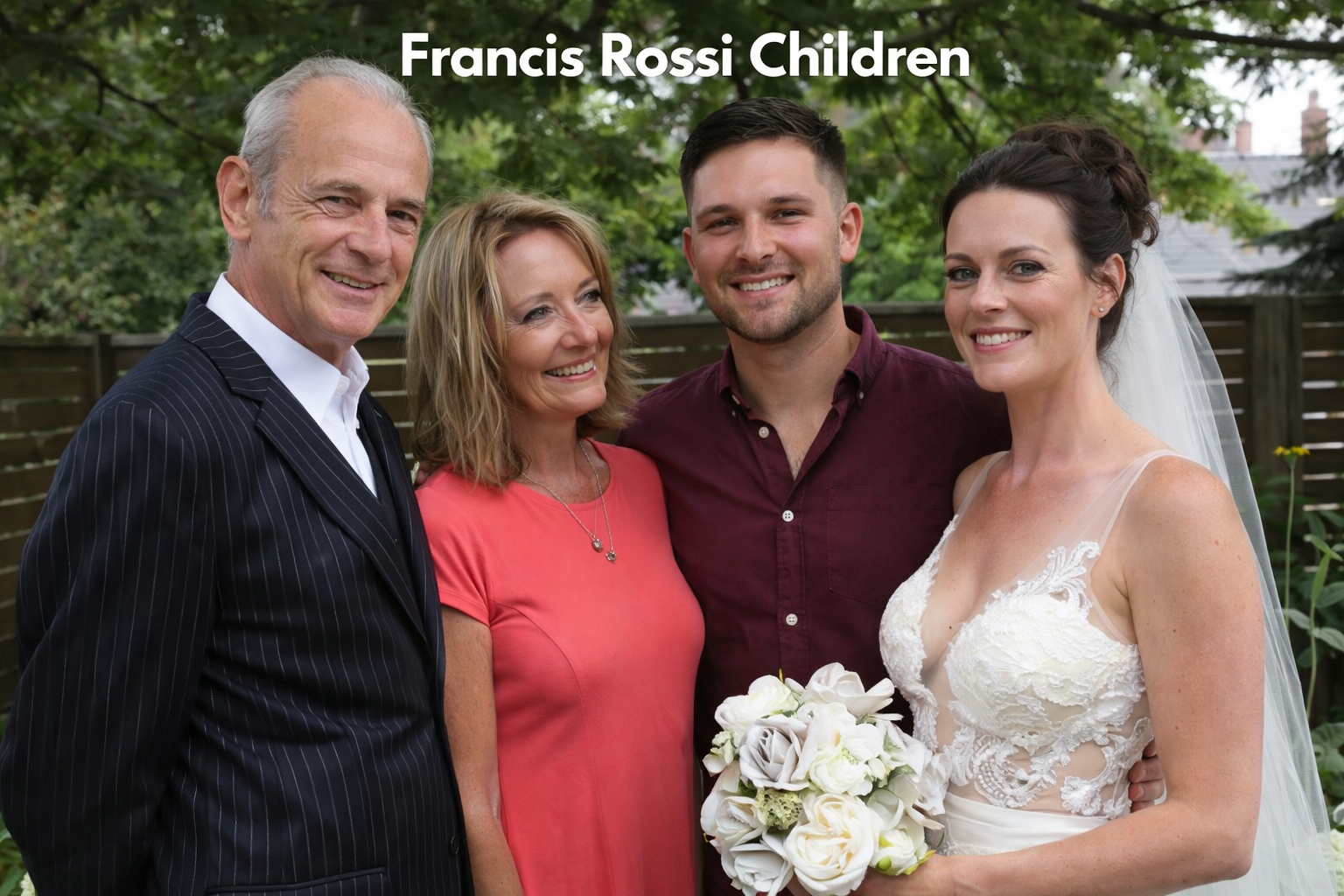
Francis Rossi has spent more than five decades as the driving force behind Status Quo, earning his place among the most enduring figures in British rock history. The low-slung guitar, the distinctive vocals, the tireless stage energy — these are the things the world sees. What the world does not see is the man who raised a family through all of it, quietly and deliberately, far from every camera and headline.
Questions about Francis Rossi children surface regularly among fans who want to understand the full picture of the man, not just the musician. How many kids does he have? Who are their mothers? Have any followed him into music? The answers reveal something more interesting than simple biographical facts — they reveal a set of values that Francis Rossi has held without compromise across his entire adult life.
The Foundation of a Family Man
| Detail | Information |
| Full Name | Francis Dominic Nicholas Michael Rossi |
| Date of Birth | May 29, 1949 |
| Place of Birth | Forest Hill, London, England |
| Nationality | British |
| First Wife | Eileen Brabrook (married 1971, divorced 1992) |
| Second Wife | Patrizia Rossi (married 2001) |
| Total Children | 8 across both marriages |
| Net Worth | Estimated $8 million |
| Major Awards | OBE (2010), Brit Award for Outstanding Contribution (1991) |
| Autobiography | I Talk Too Much (2019) |
Francis Rossi’s personal life took its most defining shape at precisely the moment his professional life was exploding. Status Quo was ascending through the early 1970s, building the boogie-rock reputation that would eventually shift over 128 million albums worldwide. Into that whirlwind, Rossi married Eileen Brabrook in 1971 and stepped into fatherhood for the first time.
The collision of rising fame and new domestic responsibility could have gone either direction. Many rock musicians of that generation allowed the road to swallow their family lives entirely. Rossi made a different calculation. He separated the two worlds with intention — not perfectly, and not without cost, but with a consistency that ultimately defined his personal biography as much as any chart position.
Family life, in his own words and in the observations of those around him, provided a grounding force that the Status Quo lifestyle could never replicate. Being a father gave him something the stage could not — a relationship with the world that had nothing to do with performance.
The Rossi-Brabrook Children: A Private Upbringing
Francis Rossi and Eileen Brabrook had two children together during their marriage, which lasted until 1992. A son and a daughter. Beyond that, public record goes silent — and that silence is entirely by design.
Raising children during the peak of Quo-mania in the 1970s and 1980s meant navigating a cultural moment when celebrity offspring were fair game for tabloid interest. Rossi closed that door before it could open. His kids attended school, made friends, and grew through adolescence without their surname becoming a burden or a novelty. No arranged photo opportunities. No managed access for friendly journalists. Nothing that would attach a public identity to people who had not chosen one.
This approach to celebrity children privacy is not common, and it is not easy to sustain across decades. The fact that it held — that the Francis Rossi kids from his first marriage remain entirely private individuals today — speaks to how seriously he took the commitment. Independent, self-directed, free from the weight of inherited recognition: that is the outcome he built for them, and it stands as a quieter achievement than anything Status Quo put on vinyl.
A New Chapter: Family Life with Patrizia
Following his divorce from Eileen Brabrook, Francis Rossi’s personal life entered a new phase. He met Patrizia, a wardrobe assistant, and the two married in 2001. Their relationship extended his journey as a father well into the 21st century, adding more children to a family that was already, by any standard, substantial.
By the time these younger children arrived, Rossi occupied a very different position in his own life. The frantic energy of chasing success had settled into the steadier rhythm of an artist who had already proven everything he needed to prove. Whether that translated into a different style of fatherhood — more patient, more present in a different way — is something only those inside the family would know with certainty.
What is publicly observable is the continuity of his approach. The Francis Rossi children from his marriage to Patrizia are protected with the same discipline applied to the first generation. Their names are not confirmed in any public source. Their ages remain unverified. The protective principle did not relax with time or with the changing media landscape — it adapted to meet new challenges while holding the same underlying line.
Balancing the Road and the Home
Status Quo’s touring schedule was, for many years, among the most demanding of any band in rock history. Hundreds of shows per year, commitments across multiple continents, recording obligations filling the gaps between tour legs. For a father trying to be present, this created a structural problem with no clean solution.
Rossi has never pretended otherwise. In various interviews across his career, he acknowledged the specific pain of missing family milestones — the birthdays that came and went while he was somewhere in Europe, the school events that existed only in photographs sent after the fact. Balancing family and career at that level of professional intensity involves loss, and he did not dress it up as something else.
What he controlled was the quality of his presence when he was home. The family home in England functioned as a genuine sanctuary — a place where the rock musician persona was genuinely set down, not merely paused. His children understood the shape of their father’s work. What they did not have cause to doubt was where his priorities actually lived. The Francis Rossi personal life, whatever its complications, was always anchored to home.
The Protective Principle: Shielding from the Spotlight
The single most consistent feature of Francis Rossi’s approach to fatherhood is protection. Not protection in an anxious or controlling sense, but in the deliberate, principled sense of refusing to use his children as accessories to his public identity.
Fame, in practical terms, is a resource that can be deployed. It opens doors, generates coverage, builds associations. Rossi had every opportunity to leverage his celebrity children in ways that would have been considered normal, even positive, within the entertainment world. He chose not to. No magazine spreads. No appearance at award ceremonies framed as a family occasion. No social media content engineered to show a warmer, more relatable side of the rock star.
This restraint was not coldness. It was the opposite. By keeping the Francis Rossi kids entirely out of public view, he ensured they could build lives assessed on their own terms. They were never “the children of” in any meaningful social sense. They were simply themselves — which is, for a person trying to develop a genuine identity, the only starting point that actually works.
Legacy, Not Lineage: The Children’s Own Paths
Among the notable details in the story of Francis Rossi’s family is the apparent absence of any of his children from the music industry. Given that their father co-founded one of the most successful rock bands in British history, this is not the obvious outcome. A household shaped by that level of musical passion and professional experience would naturally expose children to music from their earliest years.
What it did not do, evidently, was pressure them toward it. The Francis Rossi children appear to have chosen their own directions, in fields that have nothing to do with their father’s career. This is the kind of outcome that only happens when a parent makes a deliberate choice not to push — when the implicit message at home is that passion is something you discover, not something you inherit.
Rossi’s pride in his children, on the occasions he has expressed it, connects to who they are rather than what they do. That distinction matters. It separates a parent who wants their children to reflect well on them from one who genuinely wants their children to thrive on their own terms. Everything about his approach to Francis Rossi family life suggests the latter.
Fatherhood in Lyrics and Reflection
Status Quo’s body of work was never built on confessional songwriting. Rossi is not the kind of artist who processes his domestic life through lyrics or speaks openly about personal relationships in interviews designed to sell albums. The music operates at a different register — energetic, direct, rooted in groove and momentum rather than introspection.
And yet. Listening across fifty years of output, certain themes recur with enough frequency to feel like something more than coincidence: perseverance through difficulty, the value of what lasts, the passage of time, love that sustains rather than dazzles. These are the preoccupations of someone who has been watching his own life carefully — not just the glamorous parts.
When interviewers do steer the conversation toward family, the change in Rossi is visible. The quick, sardonic wit he deploys so naturally in professional contexts gives way to something more considered. He has described his family as the consistent reminder that he was a person rather than a performer — a distinction he returns to with what sounds like genuine gratitude rather than rehearsed humility.
The Evolution of a Rock and Roll Dad
The Francis Rossi who became a father for the first time in the early 1970s and the Francis Rossi raising younger children in the 2020s are the same person navigating a vastly different world. The challenges of protecting celebrity children privacy in an era of tabloid journalism are fundamentally unlike the challenges of doing the same thing when information circulates instantly and anonymity requires constant active management.
His method has had to evolve. What worked in 1975 — managing physical access, keeping a low residential profile — is insufficient in an age where a single tagged photograph can reach millions of people before anyone thinks to object. Adapting to that reality while maintaining the same underlying commitment requires ongoing effort, not just a standing principle.
What has not changed is the reason for it. Every adjustment in approach has served the same goal: giving his children room to be themselves without the noise of his public identity filling that room first. That consistency — across cultural shifts, across decades, across two marriages and eight children — is the defining feature of his parenting story, and it is not a small thing.
A Comparative Glance: Fatherhood in the Rock Pantheon
Understanding where Rossi sits among his peers requires seeing the full range of choices rock musicians make about family and public life. The comparison below places his approach alongside several contemporaries whose careers occupy similar cultural territory.
| Rock Figure | Band / Career | Family Approach | Defining Paternal Style |
| Francis Rossi | Status Quo | Complete, sustained separation of family from public identity across five decades | The Steadfast Protector |
| Rod Stewart | Solo / The Faces | Warm, managed integration; family featured positively in media coverage | The Celebratory Father |
| Bob Dylan | Solo | Deep, enigmatic privacy; children nearly invisible across entire career | The Mythic Recluse |
| Dave Grohl | Foo Fighters | Relatable public warmth; shares family anecdotes openly in interviews | The Everyman Dad |
| Ozzy Osbourne | Black Sabbath | Complete public integration through reality television; family became the narrative | The Unfiltered Patriarch |
What this comparison clarifies is that Rossi’s position is neither the most extreme in terms of privacy nor the most open. Bob Dylan’s children are arguably even less visible. Ozzy Osbourne’s family became a television franchise. Rossi occupies different ground — he acknowledges fatherhood openly as a central part of his identity, while drawing an absolute boundary around the people that identity involves. That particular combination of acknowledgment and protection is, among major rock figures, genuinely distinctive.
The Unseen Support System
The privacy surrounding the Francis Rossi children did not maintain itself. Behind it stands the sustained effort of the women who raised those children through the long stretches when Rossi was elsewhere.
Eileen Brabrook carried the primary domestic weight during the years when Status Quo was at its commercial peak — arguably the most demanding touring period of the band’s career. Patrizia has done the equivalent in the decades since. The school runs, the homework, the daily rhythms of raising children in a stable and grounded way — this work was done by people who never sought recognition for doing it, and whose contribution to the outcome is inseparable from Rossi’s own.
This is not a footnote in the story of the Francis Rossi family. It is structural. The confident, private, self-possessed adults his children appear to have become are the product of consistent maternal presence as much as paternal protection. Any account that centres only on Rossi’s role is missing half the architecture.
The Values Passed Down
Children learn more from sustained observation than from anything explicitly taught. What the Francis Rossi kids absorbed across their years in this household was not a curriculum — it was a demonstration.
Work ethic, first. A man who has performed live for over fifty years, who continued working through personal health challenges and the disruption of a global pandemic, who has never treated his craft as something to coast through — that level of sustained dedication communicates something no conversation about the importance of hard work could match.
Alongside it, the value of holding a line. The boundaries around their privacy were never softened for convenience or suspended when a good opportunity arose. They were maintained absolutely. In watching that, his children learned that values are not positions you take in the abstract — they are choices you make repeatedly, under varying degrees of pressure, until they become simply who you are.
And beneath everything, expressed through decades of consistent action rather than declaration: unconditional love of the kind that respects rather than possesses, that protects without controlling, and that ultimately trusts the people it loves to find their own way.
The Grandfather Chapter
Francis Rossi’s older children are now adults living independent lives. The logical progression of those lives — careers, relationships, families of their own — makes it highly probable that he has already entered grandfatherhood, though nothing of the sort has been confirmed publicly, and nothing would be expected to be.
This chapter, if it has arrived, carries a different texture from active parenthood. The professional pressure that once pulled against family time has eased. The balancing act that defined so many years of his life has given way to something less fraught. Grandfatherhood tends to offer the pleasures of family connection without the weight of primary responsibility — a form of presence that can simply be enjoyed.
Whatever this stage holds for Rossi, it unfolds behind the same walls he has always maintained. The quiet satisfaction of it — a family intact, self-sufficient, gathered around someone who worked to keep it that way — is perhaps the most fitting conclusion to a story that was never going to be told loudly.
Frequently Asked Questions
How many children does Francis Rossi have in total?
According to available biographical sources, Francis Rossi has eight children across both of his marriages, though he has never personally confirmed this figure publicly.
What are the names of Francis Rossi’s children?
No names have ever been publicly confirmed by Rossi or his family, consistent with his lifelong commitment to keeping his children entirely out of the public record.
Have any of Francis Rossi’s children pursued a music career?
There is no public evidence of any of his children working professionally in music, suggesting they have each chosen independent paths in fields unconnected to their father’s career.
How did Francis Rossi balance his touring schedule with raising a family?
He prioritised the quality of time at home over its quantity, maintained a stable family base in England, and relied heavily on the consistent support of his children’s mothers during prolonged absences.
Why does Francis Rossi keep his personal life so private?
He has consistently held that his children deserve the freedom to build their own identities without public scrutiny, treating privacy as the most meaningful form of protection he could offer them.
Is Francis Rossi a grandfather?
Given that his older children are now adults, it is considered very likely — though in keeping with his approach to family privacy, no details have been shared publicly.
What lasting values has Francis Rossi passed on through his parenting?
His children grew up watching sustained work ethic in practice, observing firm personal boundaries held without compromise, and experiencing unconditional love expressed through consistent action across decades.
Conclusion
The story of Francis Rossi children is written largely in negative space — in the absence of headlines, the absence of photographs, the absence of the public moments that define so many celebrity families. That absence is not emptiness. It is the deliberate outcome of fifty years of principled parenting by someone who understood that protecting his children’s ordinary lives was the most meaningful use of his extraordinary position.
His eight children grew up with a father who was sometimes on the other side of the world but never, in any meaningful sense, absent from what mattered most. The values he modelled, the boundaries he held, the love he expressed through action rather than announcement — these are the things that shaped who they became.
Francis Rossi’s contribution to rock music is documented in platinum certifications, sold-out venues, and a catalogue that has outlasted every trend that tried to make it obsolete. His contribution as a father is documented nowhere publicly — and that, more than anything else, is exactly how he intended it.

Den Mark is a passionate writer specializing in celebrity news, biographies, and net worth insights. With a keen eye for detail, he brings readers the latest updates and intriguing stories from the world of fame.