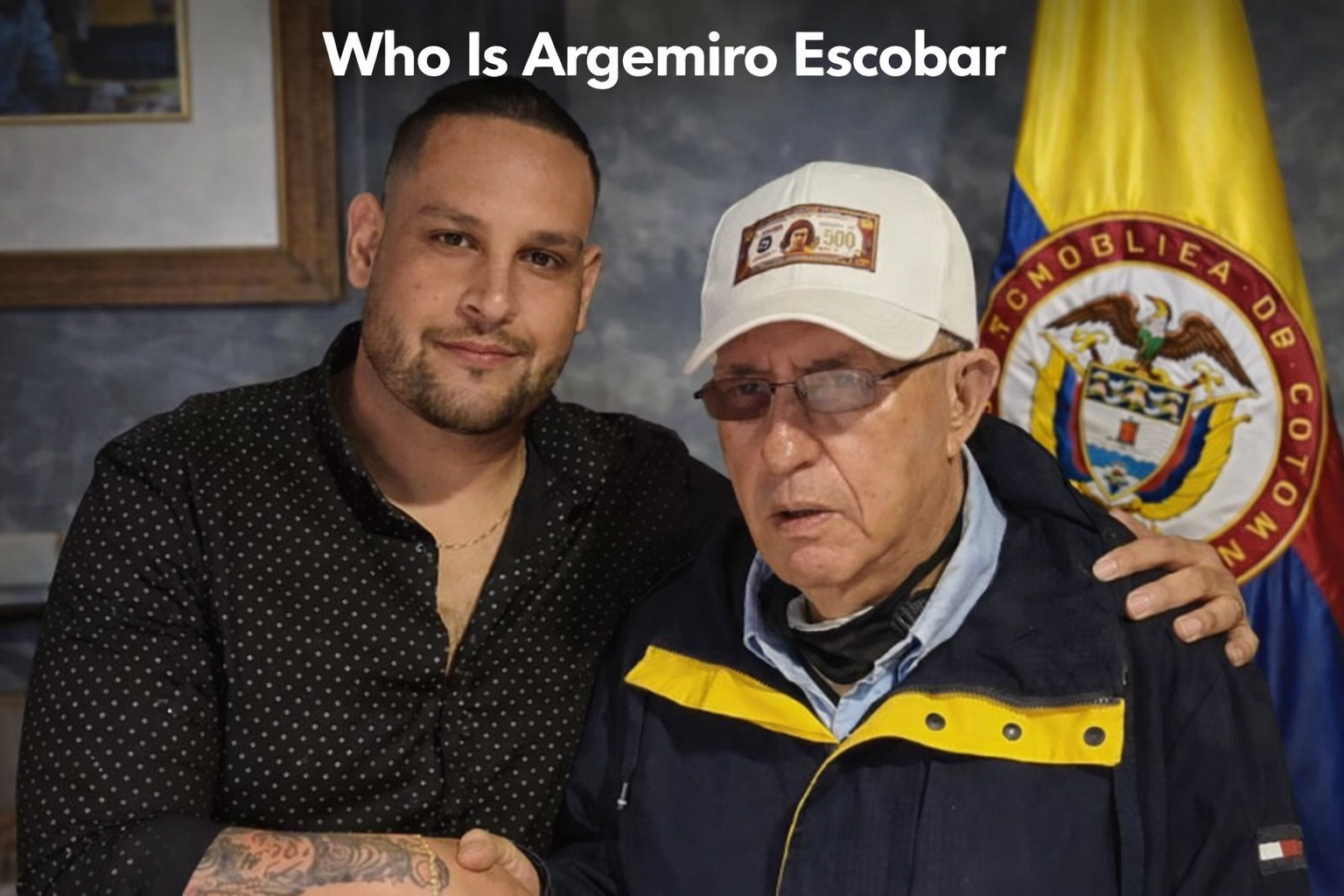
Argemiro Escobar remains one of the most overlooked figures connected to Colombia’s most infamous family. As the older brother of Pablo Escobar, he could have walked a path paved with cartel money and criminal power. Instead, he chose classrooms over crime, education over empire, and anonymity over infamy. While Pablo Escobar’s name became synonymous with the Medellín Cartel’s reign of terror, Argemiro quietly lived out his days as a schoolteacher in rural Colombia. He passed away in 2020 at age 81, largely unknown to the outside world. His story is not one of violence or headlines — it is one of deliberate silence, moral strength, and a life lived entirely on his own terms.
Quick Bio of Argemiro Escobar
| Category | Details |
| Full Name | Argemiro Escobar Gaviria |
| Date of Birth | 1939 |
| Date of Death | 2020 |
| Age at Death | 81 years old |
| Nationality | Colombian |
| Profession | Schoolteacher |
| Famous For | Being Pablo Escobar’s older brother |
| Parents | Abel de Jesús Escobar and Hermilda Gaviria |
| Siblings | Pablo Escobar, Roberto Escobar, and others |
| Criminal Involvement | None — completely distanced from the Colombian drug trade |
| Public Profile | Extremely private throughout his lifetime |
| Residence | Colombia |
| Legacy | Represented the honest, non-criminal side of the Escobar family tree |
Family Roots of Argemiro Escobar
Argemiro Escobar Gaviria was born in 1939 into a working-class family in the Antioquia region of Colombia. The landscape of rural Antioquia — its mountains, farms, and tight-knit communities — shaped the worldview of everyone raised there, including all seven children of the Escobar family tree. Life was modest by any measure. Resources were limited, and daily survival required consistent effort from every member of the household.
His father, Abel de Jesús Escobar, spent years farming a small plot of land and later took on work as a rural watchman to supplement the family income. His mother, Hermilda Gaviria, worked as an elementary school teacher who carried her profession with great pride. The values she promoted inside her classroom — discipline, learning, and civic responsibility — were the same ones she reinforced at the dinner table each evening.
Argemiro absorbed those lessons deeply. He grew up observing his mother’s dedication to community through rural Colombia education, and that early influence would define his entire adult life. When the time came to choose a profession, he followed her example almost instinctively. Teaching was not just a career for him — it was a continuation of the family tradition his mother had started.
The Escobar household was grounded in Colombian peasant culture, where family bonds were forged through shared hardship rather than wealth. Seven children growing up under one roof created both camaraderie and complexity. Each sibling would eventually find their own path, but the roots planted in that rural Antioquian home stayed with all of them — even those who later chose to abandon everything those roots stood for.
Who Were Abel de Jesús and Hermilda?
Abel de Jesús Escobar was a man of the Colombian countryside in the truest sense. He worked the land with persistence, dedicating long days to agricultural labor that barely kept pace with the needs of a growing family. He later transitioned into work as a watchman, a role that offered steadier income in a region where seasonal farming could not always guarantee stability. He was not a man of words or grand gestures — he was a man defined by routine, responsibility, and quiet endurance.
Hermilda Gaviria brought a different kind of strength to the household. Educated and purposeful, she worked as a primary school teacher who believed deeply in the transformative power of learning. In rural Colombian communities of that era, a female educator who both taught professionally and raised a large family was genuinely remarkable. She was widely respected by her neighbors and regarded within her community as someone who gave more than she ever asked for in return.
Together, Abel and Hermilda tried to raise their children with two complementary values — the dignity of physical labor and the power of intellectual growth. They were practicing Catholics who emphasized moral behavior as a social obligation, not just a private virtue. Their home may have been small, but the principles inside it were not.
Their greatest heartbreak would eventually arrive through Pablo, their youngest prominent son, who dismantled everything they had built in terms of Escobar family legacy and reputation. Despite their most sincere efforts, neither the hard work of Abel nor the moral teachings of Hermilda could redirect Pablo once he had committed himself to building a criminal empire. That failure was not one of parenting — it was a reminder that individuals ultimately make their own choices regardless of the environment they were raised in.
Brothers and Sisters Around Argemiro Escobar
The Escobar household produced seven children, and the differences between their life choices could not be more dramatic. Among the Pablo Escobar siblings, Argemiro was among the older children, while Pablo — born in 1949 — was a decade younger. That age gap meant Argemiro was already establishing his adult identity while Pablo was still a child absorbing the streets of Antioquia with different eyes.
Roberto Escobar, often called “El Osito,” became the sibling most directly embedded in Pablo’s operations. He served as the cartel accountant and financial brain behind the Medellín Cartel, tracking the movement of money on a scale that most people cannot comprehend. Billions of dollars passed through operations he helped manage. Roberto later wrote about this in his memoir, offering a rare insider’s perspective on cartel finances and the logistics of running a criminal organization of that magnitude. He served a lengthy prison sentence for his involvement.
The Escobar sisters — among them Luz María Escobar and Alba Marina Escobar — lived far more quietly than their brothers. They were never implicated in cartel activities and mostly tried to maintain ordinary lives, though the family name made ordinary nearly impossible. Every time Pablo made international news, the women connected to that surname felt the reverberations in their own communities. There was also Luis Fernando Escobar, the youngest sibling, whose life was tragically cut short in 1977 at just nineteen years old — a victim not of crime, but of a fatal accident involving a drunk undercover officer. Then there was Gloria Inés Escobar, another sibling about whom almost nothing has been recorded publicly.
Argemiro occupied a unique position among all the Pablo Escobar siblings. He was not involved in crime like Roberto, nor was he publicly celebrated or condemned. He was simply absent from the narrative entirely. No cartel connection, no arrest, no memoir, no documentary appearance. For a man belonging to one of the most documented criminal families in modern history, that level of invisibility required genuine and sustained intention.
A Quiet Life for Argemiro Escobar
Argemiro Escobar spent his professional years doing exactly what his mother had done before him — teaching children in Colombian schools. As a Colombian schoolteacher, he worked in local institutions where he focused on instilling both knowledge and character in his students. There was nothing glamorous about his daily routine, and that was precisely the point. He had no interest in glamour or recognition of any kind.
He lived a completely private life in Colombia, in a home that reflected his priorities — practical, private, and entirely removed from the circles his brother Pablo moved through. While Pablo was constructing private zoos, buying politicians, and ordering assassinations, Argemiro was grading papers and preparing lesson plans. The contrast between the honest life he lived versus the criminal path his brother took was not just moral — it was almost surreal in its scale.
What makes Argemiro’s choice particularly significant is that it was not made in ignorance. He understood what Pablo was doing. He came from the same family, shared the same blood, and grew up under the same roof. He was not sheltered from the reality of his brother’s world — he simply refused to enter it. That refusal was a daily, active decision sustained over decades.
He never attempted to monetize his family connection, never sold his story to media outlets, and never used the Escobar name to gain personal advantage. Even as Pablo’s legend grew and the global fascination with the Medellín Cartel exploded into books, documentaries, and Narcos on Netflix, Argemiro remained entirely off-screen. He died in 2020 at 81 years old — a man who lived fully on his own terms, in peaceful obscurity.
Abel de Jesús Escobar Echeverri: Kidnapping and Death
The violent chapters of Colombian history did not spare even the most innocent members of the Escobar family. Abel de Jesús Escobar Echeverri — Pablo’s father and Argemiro’s father — found himself pulled into danger years after Pablo’s death, in a tragic incident that underscored just how long the cartel’s shadow stretched across Colombia.
In 2001, eight years after Pablo was shot dead on a Medellín rooftop following his Pablo Escobar death in 1993, Colombian guerrilla fighters kidnapped the elderly Abel. He was well into his seventies at the time — frail, retired, and entirely removed from any criminal world. The kidnappers were not interested in his personal connection to crime. They were interested in the Escobar family name and whatever financial leverage it still carried. A ransom demand was issued.
The family scrambled to negotiate and eventually secured his release after several months in captivity. Abel had survived, but the experience left visible damage. Months of physical and psychological stress under harsh conditions had taken a severe toll on a body that no longer had the resilience of youth. He was not the same man who had been taken.
Abel de Jesús died in October 2001, only a short time after returning home. The Colombian guerrilla kidnapping had accelerated a physical decline that might otherwise have developed gradually. His death closed the chapter on the generation that had originally built the Escobar family — the generation of farmers and teachers and quiet dignity — long before their son’s choices made their name something the whole world would come to recognize for the worst possible reasons.
Grandchildren and Legacy
The generation that came after Pablo Escobar has spent enormous energy trying to redefine what the Escobar family legacy means. Pablo’s own son, Juan Pablo Escobar, legally changed his name to Sebastián Marroquín and relocated to Argentina. He became an architect and author who has devoted significant public effort toward acknowledging the suffering his father caused. His appearances at conferences and in documentaries reflect genuine attempts at accountability rather than reputation management.
Pablo’s daughter Manuela Escobar also changed her name and settled abroad, pursuing the same kind of private life in Colombia that her uncle Argemiro had always practiced. The children of Pablo grew up carrying a burden no child should inherit — the crimes of a father who inflicted mass suffering on an entire nation.
Argemiro’s own descendants had a different inheritance entirely. They grew up connected to a grandfather whose Escobar legacy was one of professional service and personal restraint. No public record documents them in detail, which is itself a reflection of how successfully Argemiro insulated his family from outside scrutiny. They carry the Escobar name without the cultural weight that Pablo attached to it.
The broader Escobar family legacy is one of profound contradiction. Within the same household, the same parents, the same economic conditions in Antioquia Colombia, arose a man who terrorized a country and a man who spent decades teaching its children. Argemiro’s story does not redeem Pablo’s crimes — nothing can. But it does complicate the instinct to judge an entire family by its most destructive member. It insists that individuals, not bloodlines, determine moral outcomes.
Why So Little Is Known About Argemiro Escobar
The scarcity of information about Argemiro Escobar is not an accident of history — it is the direct result of choices he made continuously throughout his life. He never approached journalists, never participated in documentaries about the Escobar family, and never collaborated on any of the many books written about Pablo and the Medellín Cartel. His silence was total and deliberate.
From a media perspective, there was simply no story to tell in the conventional sense. Argemiro had no criminal record, no cartel involvement, no dramatic arc of rise and fall. Investigative reporters gravitating toward the Escobar family were drawn to Pablo’s violence, Roberto’s financial confessions, or the survival stories of Pablo’s immediate family. A soft-spoken Colombian schoolteacher who went to work every day and came home every evening offered nothing that could compete for column inches.
The surviving members of the Escobar family also played a protective role. In published accounts and media appearances, Argemiro’s name rarely surfaces. The family seems to have collectively honored his preference for privacy, keeping him out of discussions that would have exposed him to unwanted attention or potential danger from Pablo’s remaining enemies in the Colombian drug trade.
His story also reflects a broader truth about how history is recorded. Notoriety generates documentation. Quiet lives, no matter how meaningful, leave fewer traces. Argemiro Escobar lived a life that mattered deeply to everyone in his immediate sphere — his students, his neighbors, his family — but never generated the kind of public record that survives in archives or trending searches. That absence is not a measure of his significance. It is simply a measure of how thoroughly he succeeded in living on his own terms.
Frequently Asked Questions
What was Argemiro Escobar’s relationship to Pablo Escobar?
Argemiro was Pablo Escobar’s older brother, born approximately a decade before Pablo in 1939.
Did Argemiro Escobar work in the drug cartel?
No — Argemiro had zero involvement in the Medellín Cartel and spent his entire career as a Colombian schoolteacher.
When did Argemiro Escobar die?
Argemiro Escobar passed away in 2020, having lived to the age of 81.
How many siblings did Pablo Escobar have?
Pablo grew up alongside six siblings, including Argemiro, Roberto, Luz María, Alba Marina, Gloria Inés, and Luis Fernando.
Why is Argemiro Escobar not famous like Pablo?
He actively chose a private life in Colombia, avoided all media contact, and built an existence entirely separate from Pablo’s criminal world.
What did Argemiro Escobar do for a living?
Argemiro worked as a schoolteacher throughout his career, following the professional path of his mother Hermilda Gaviria.
Was Argemiro Escobar ever arrested?
No — he was never arrested or charged with any crime, having kept complete distance from the Colombian drug trade.
Who were Argemiro Escobar’s parents?
His parents were Abel de Jesús Escobar, a farmer and watchman, and Hermilda Gaviria, an elementary school teacher.
Did Argemiro Escobar have any children?
Details about his personal family life remain private, fully consistent with how he conducted his entire life.
How did Argemiro Escobar avoid cartel life?
He made a sustained, conscious choice to pursue rural Colombia education and stay completely disconnected from Pablo’s criminal network.
Final Thought
Argemiro Escobar’s life offers something rare in the broader Escobar narrative — a story entirely free of bloodshed, corruption, or moral compromise. He was born into the same Escobar family Colombia that produced one of history’s most destructive criminals, and he used that same upbringing to build something entirely opposite. A classroom instead of a cartel. A teaching salary instead of drug money. A private death at 81 instead of a violent end on a rooftop.
His existence challenges the lazy assumption that environment determines destiny. He had every reason the world might accept for going wrong — poverty, a notorious sibling deep inside the Colombian drug trade, access to cartel wealth — and he rejected all of it. Not with fanfare, not with public declarations of virtue, but simply by showing up to work every day and going home every night.
Argemiro Escobar will never trend. No Netflix series will carry his name in its title the way Narcos carried his brother’s. But for anyone genuinely interested in what the Escobar family actually produced in full — not just its worst chapter — his story deserves to be told with the same seriousness as his brother’s.

Den Mark is a passionate writer specializing in celebrity news, biographies, and net worth insights. With a keen eye for detail, he brings readers the latest updates and intriguing stories from the world of fame.