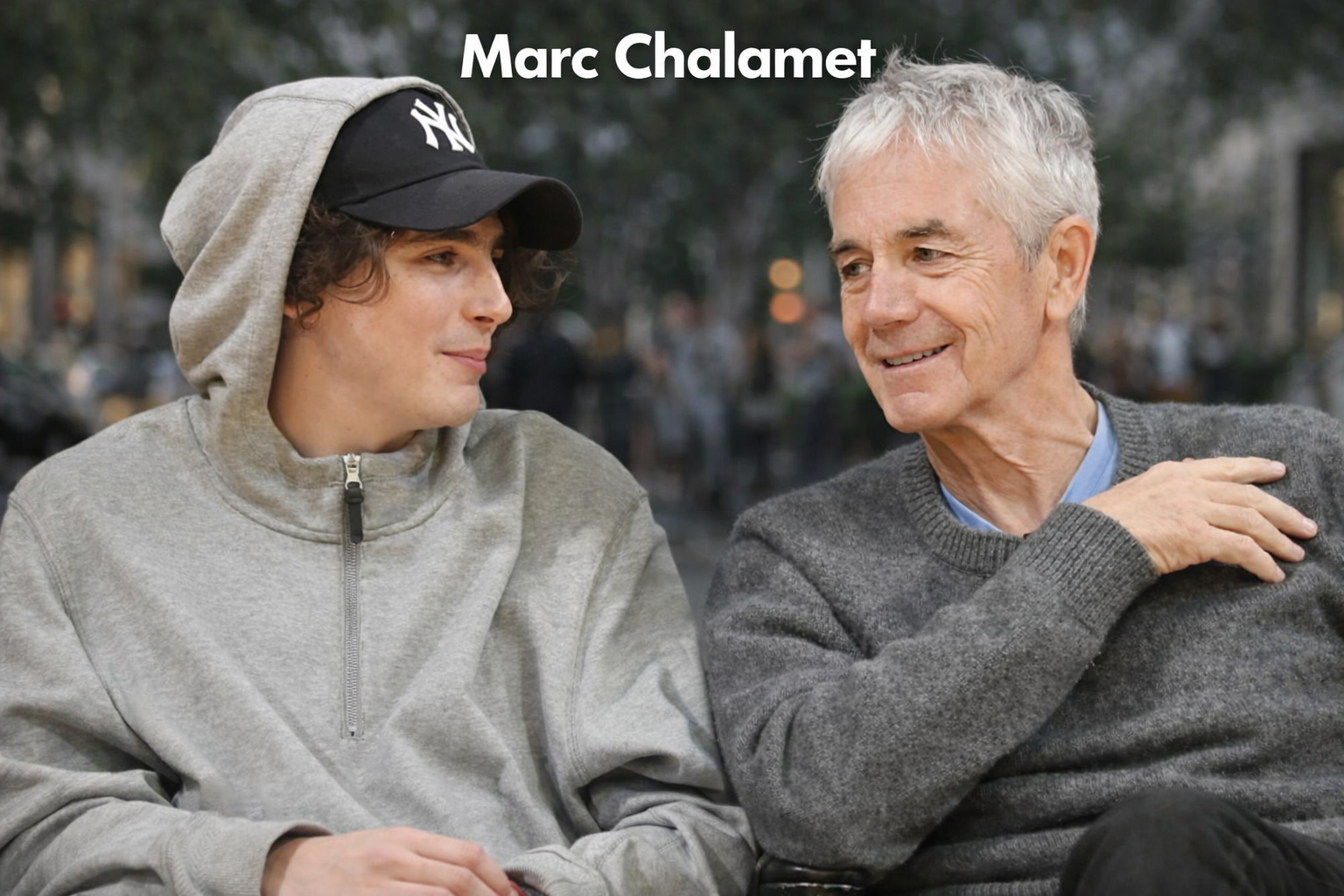
When the world fell in love with Timothée Chalamet — the actor behind iconic roles in Call Me by Your Name, Dune, and Wonka — very few looked beyond the camera to the man who quietly shaped his values, his bilingual fluency, and his instinct for meaningful storytelling — Marc Chalamet. A French-American journalist, editor, and translator holding dual French and American citizenship, Marc’s story is not one of red carpets or Hollywood parties, but of intellect, cultural depth, and quiet mentorship that left a lasting mark on one of this generation’s most compelling actors.
This article explores the full picture of Marc Chalamet’s background — from his journalism career at Le Parisien to his humanitarian work with UNICEF and the United Nations, his role in shaping the multicultural Chalamet household, and why public curiosity about Timothée Chalamet’s dad continues to grow. If you are looking to understand the roots behind the fame, this is where the story really begins.
Who Is Marc Chalamet?
Marc Chalamet is a French-American journalist, editor, and French-English literary translator whose name has become increasingly searched as his son Timothée’s global profile has risen. Born and raised in France with dual French and American citizenship, Marc built his professional identity through rigorous journalism and cross-cultural communication long before the Chalamet legacy became a Hollywood talking point.
He is best known publicly as Timothée Chalamet’s father, but that description significantly undersells his own career. For years, Marc contributed to Le Parisien newspaper, one of France’s most respected daily publications, covering socio-political issues and international affairs. He later channelled that same commitment to diplomacy and storytelling into editorial and communications work with UNICEF and the United Nations, where humanitarian advocacy became his primary focus.
Fluent in both French and English, Marc is also an accomplished literary translator working across fiction and non-fiction. His deep command of both languages has allowed him to bring nuanced international works to new audiences while preserving the integrity of original texts. He represents, in many ways, the archetype of substance over spectacle — an intellectual figure whose influence is felt everywhere except the headlines.
Career in Journalism
Marc Chalamet’s professional foundation is grounded in journalism. As a writer for Le Parisien, he covered a broad spectrum of news with a consistent emphasis on socio-political issues and international affairs. His work across Paris-based media circles and later in New York demonstrated a commitment to factual, empathetic storytelling that would inform everything that followed.
His transition to UNICEF and broader United Nations communications work marked a natural evolution — from reporting on the world’s problems to actively contributing to solutions. In those roles, Marc focused on global development, humanitarian storytelling, and communicating complex and sensitive issues to international audiences. It was, as one profile described it, journalism of a very different nature — rooted in diplomacy and storytelling rather than deadlines and bylines.
His career gave him access to intellectual and literary circles in both New York and Paris, where he continues to maintain a quiet but respected presence. For a man whose son is one of the most photographed people on the planet, Marc’s own professional world operates almost entirely without a camera in sight — a living demonstration of integrity over fame.
Cultural Influence on Timothée Chalamet
It is no coincidence that Timothée Chalamet — the actor praised for his thoughtful communicator instincts and cultural fluency — speaks fluent French, gravitates toward complex European cinema, and consistently chooses roles that prioritise depth over spectacle. The Marc Chalamet influence on his son’s sensibility is visible at every turn.
From an early age, Timothée was immersed in French literature, global current affairs, and cross-cultural dialogue — all direct products of his father’s intellectual environment. Marc reportedly insisted on bilingual education for both Timothée and his sister Pauline Chalamet, ensuring neither child would grow up with only one cultural lens through which to interpret the world.
The family maintained strong ties to France, including regular visits to Le Chambon-sur-Lignon, the family’s village in the French countryside, where the slower rhythm of rural European life offered a grounding contrast to New York’s intensity. These experiences — reading French literature, discussing global affairs at the dinner table, moving between languages without effort — shaped the cultural fluidity that Timothée’s fans and interviewers consistently remark upon.
Marc Chalamet’s influence was never about pushing his son toward acting. It was about the rarer achievement of influence without overshadowing — building the kind of person who could approach any creative work, from Call Me by Your Name to Dune, with genuine intellectual curiosity and cross-cultural empathy.
Family and Private Life
Marc Chalamet is married to Nicole Flender, a New Yorker and former Broadway dancer who later transitioned into a career as a real estate agent. Their union, based in their Manhattan family home, brought together two distinctly different worlds — French intellectual rigour and American creative energy — and the result was a blended French-American family that gave both Timothée and Pauline Chalamet an unusually rich foundation.
Pauline Chalamet, now an established actress and writer best known for her role in the HBO series The Sex Lives of College Girls, is herself a product of that same creative and intellectually open household. The fact that both children have pursued meaningful artistic careers is no coincidence — it reflects the environment Nicole Flender and Marc Chalamet deliberately built together.
The Marc Chalamet private life is, by deliberate choice, largely invisible. He does not seek interviews, does not leverage his son’s fame for personal visibility, and maintains no notable social media presence. Nicole’s background in performance arts complemented Marc’s more analytical global outlook, producing a Manhattan family home where Broadway show tunes and French literary criticism coexisted naturally.
The French-American Identity
Marc Chalamet’s life straddles two cultures with equal confidence, and that French-American identity — reinforced by his dual French and American citizenship — has shaped everything from his journalism to his parenting philosophy. He is neither fully French nor entirely American. He occupies the space between, and that in-between position has proven to be one of his greatest assets.
Whether through his work at Le Parisien, his United Nations communications roles, or the dinner table conversations that shaped Timothée’s worldview, Marc has consistently modelled cross-cultural understanding as a value rather than simply a skill. His multicultural household was not a product of circumstance — it was an intentional environment built around open-mindedness, humility and global awareness, and respect for intellectual diversity.
This dual identity is perhaps most visible in how Timothée navigates the world: equally at ease in a Paris café or a Hollywood press junket, equally comfortable discussing French New Wave cinema or the cultural significance of Wonka. That cultural fluidity did not emerge from acting school. It was absorbed at home, from a father who lived it every day.
Literary Pursuits and Translation Work
Beyond journalism and United Nations communications, Marc Chalamet has developed a serious and sustained career as a French-English literary translator. This work requires not just linguistic skill but a deep sensitivity to tone, cultural context, and authorial intent — qualities that align closely with the empathy and precision that define his journalism.
His translation work has spanned both fiction and non-fiction, bringing French-language works to English-speaking audiences and vice versa. In the literary world, translators are often described as invisible collaborators — the people whose skill makes a work accessible without ever receiving the cover credit. It is a role that suits Marc’s disposition perfectly, consistent with his broader philosophy of substance over spectacle.
In recent years, he has remained connected to academic and literary circles in both New York and Paris, quietly continuing work that most of his son’s fans have no idea exists. That rare dual literary command of French and English has allowed him to contribute meaningfully to the kind of cross-cultural intellectual exchange that defines his entire career.
The Legacy of Quiet Influence
Unlike celebrity parents who position themselves as extensions of their famous children’s brands, Marc Chalamet has played a role that is almost deliberately invisible — the very definition of influence without overshadowing. There are no joint interviews, no behind-the-scenes documentaries, and no social media accounts broadcasting paternal pride to millions of followers. And yet his influence is anything but minor.
The books on the family shelves, the political discussions around the Manhattan family home dinner table, the insistence on bilingual education, the annual trips to Le Chambon-sur-Lignon — these are the building blocks of Timothée Chalamet’s worldview, and they all trace back to his father. The Chalamet legacy in Hollywood is not just about one actor’s talent. It is about the intellectual and cultural environment that produced him.
Timothée’s passion for meaningful roles in films like Dune and Call Me by Your Name, his commitment to global causes, and his reputation as a thoughtful communicator all owe a significant debt to Marc’s quiet mentorship. That is perhaps the most lasting kind of influence — the kind that shapes a person so completely it becomes indistinguishable from who they simply are.
Expert Perspectives on Parenting and Fame
Developmental psychologists consistently identify parental modeling as one of the most critical factors in shaping a child’s emotional intelligence and creative capacity. In Marc’s case, his steady presence, worldly outlook, and commitment to intellectual engagement likely provided Timothée with the psychological grounding needed to navigate extraordinary fame — the kind that follows a Wonka or Dune release — without losing his sense of self.
Research into creative households suggests that children raised in environments balancing structure with cultural openness are significantly more likely to excel in creative fields. The Chalamet household — with its bilingual upbringing, access to global literature, exposure to both United Nations humanitarian work and Broadway performance, and consistent movement between European and American cultural frameworks — closely fits that profile.
What is particularly notable is the complete absence of industry pressure. Marc’s career had no entertainment component, meaning Timothée’s path into acting was entirely self-directed. That freedom, grounded in a secure and intellectually stimulating home shaped by both Marc Chalamet and Nicole Flender, is arguably as important as any formal training.
Comparisons with Other Hollywood Families
What distinguishes Marc Chalamet from many other fathers of famous actors is precisely what he is not. He is not a former entertainer leveraging his child’s platform. He is not a manager operating under the guise of a parent. He is not a social media presence offering a curated window into family life for public consumption.
In contrast to figures like Billy Ray Cyrus or Will Smith — celebrity parents whose own entertainment careers have intersected, sometimes problematically, with their children’s — Marc’s complete detachment from show business allowed Timothée to develop as an artist entirely on his own terms. There was no family brand to uphold and no inherited industry relationships to navigate. His background in United Nations communications and Le Parisien journalism could not be further from the Hollywood ecosystem.
This makes the Chalamet family dynamic both unusual and deeply appealing to fans who value Timothée’s authenticity. That authenticity did not emerge from image management — it emerged from a French-American upbringing built entirely around integrity over fame and substance over spectacle.
Emerging Interest in Marc Chalamet
As Timothée Chalamet’s global profile continues to expand — accelerated by major releases like Dune and Wonka — public curiosity about Marc Chalamet’s background has grown in parallel. Online searches for phrases like “Timothée Chalamet’s dad” and “Marc Chalamet journalist” have increased noticeably, reflecting a broader cultural shift toward understanding celebrities as products of specific environments and relationships rather than isolated phenomena.
Marc does occasionally attend red carpet events to support his son — and those appearances, handled with characteristic understatement, have themselves sparked interest. In an age where almost every detail of a public figure’s life is documented, Marc’s deliberate low profile paradoxically increases curiosity rather than diminishing it. The refusal to perform privacy while actually being private is itself compelling.
For those who admire Timothée’s groundedness, humility and global awareness, and cultural range, the growing interest in his father is entirely logical. Understanding Marc Chalamet — his dual French American citizenship, his United Nations career, his Manhattan family home — helps explain how someone navigates global stardom at a young age without being distorted by it. The answer, it turns out, starts at home.
FAQs
Who is Marc Chalamet?
Marc Chalamet is a French-American journalist, literary translator, and editor — best known publicly as Timothée Chalamet’s father, with a career spanning Le Parisien, UNICEF, and the United Nations.
Where is Marc Chalamet originally from?
He was born and raised in France, holds dual French and American citizenship, and has lived in New York for a significant portion of his adult life.
What did Marc Chalamet do professionally?
He worked as a journalist for Le Parisien, contributed to UNICEF and United Nations communications, and has an established career as a French-English literary translator.
Who is Marc Chalamet’s wife?
Marc is married to Nicole Flender, a former Broadway dancer turned New York real estate agent and mother of Timothée and Pauline Chalamet.
Who is Pauline Chalamet?
Pauline Chalamet is Marc’s daughter — an actress and writer best known for her role in the HBO series The Sex Lives of College Girls.
Did Marc Chalamet work in the film industry?
No — his career has no entertainment industry ties, which many observers credit as a key reason for Timothée’s authentic and self-directed development as an actor.
Why are people searching for Marc Chalamet?
Growing curiosity about Timothée Chalamet’s roots — particularly following major films like Dune and Wonka — has led fans to explore his father’s intellectual and cultural influence on the actor’s worldview.
Conclusion
Marc Chalamet will likely never walk a red carpet for himself, and that is entirely by design. As a French-American journalist, United Nations communicator, literary translator, and quietly devoted father, he represents a model of influence without overshadowing that operates entirely outside the entertainment industry’s logic — and is perhaps more powerful for it.
The Chalamet legacy visible in Timothée’s career — the cultural fluency shaped by dual French and American citizenship, the intellectual curiosity nurtured in a Manhattan family home, the instinct for substance over spectacle — traces back in no small part to a man who spent his career writing about the world, translating its literature, and raising his children to understand both. Alongside Nicole Flender, Marc built not just a family but a foundation. And that foundation, quiet as it is, has produced one of Hollywood’s most genuinely compelling voices.

Den Mark is a passionate writer specializing in celebrity news, biographies, and net worth insights. With a keen eye for detail, he brings readers the latest updates and intriguing stories from the world of fame.