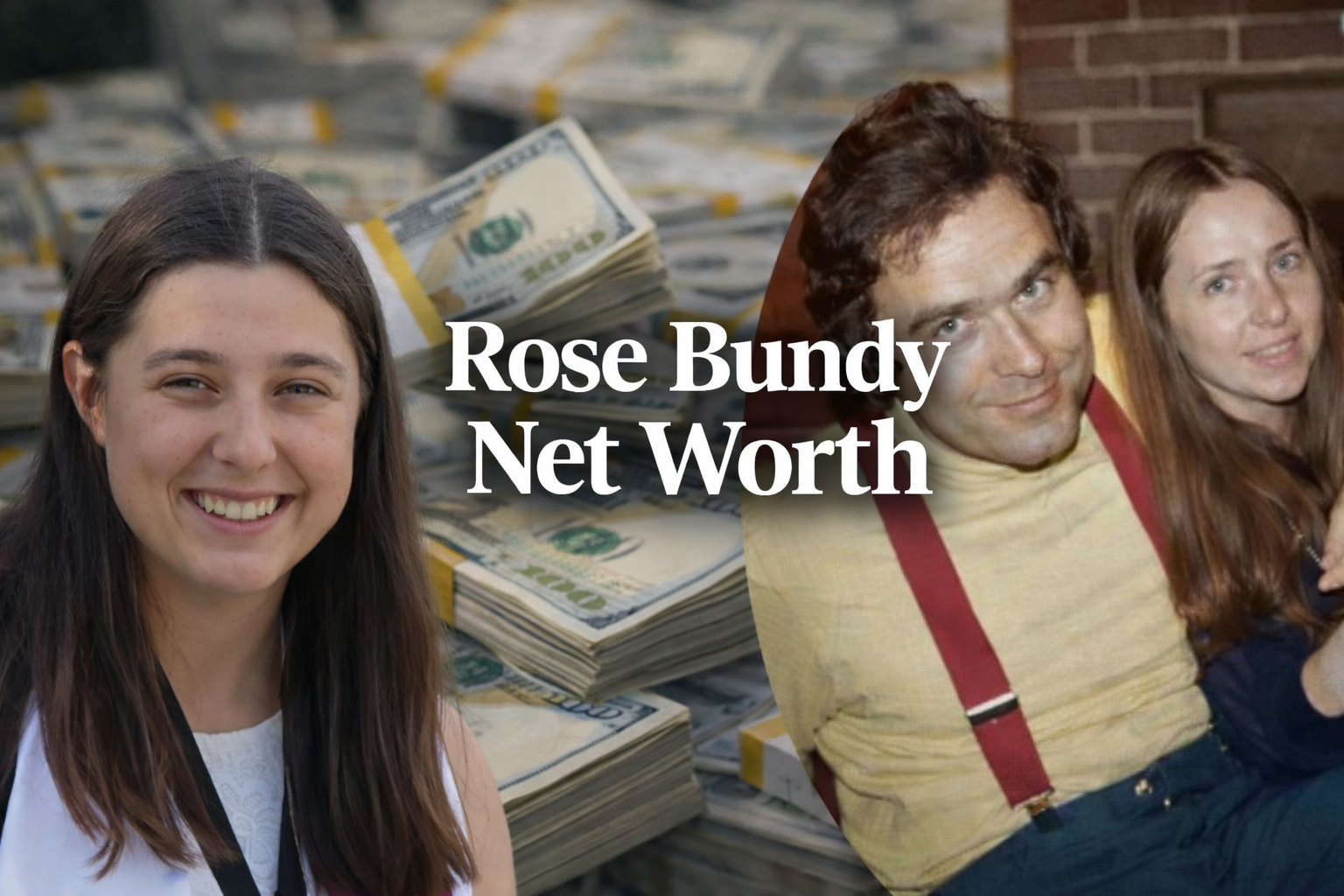
Rose Bundy, born in 1982 to one of America’s most infamous serial killers Ted Bundy and his wife Carole Ann Boone, represents one of the most enigmatic figures in true crime history. Unlike children of other notorious criminals who have occasionally stepped into the public eye, Rose has maintained absolute anonymity throughout her life. The question of Rose Bundy’s net worth has become a subject of intense curiosity, fueled by public fascination with true crime media and the bizarre circumstances of her conception during her father’s murder trial on death row.
The reality of Rose Bundy’s financial situation is far removed from the sensationalized speculation that often surrounds children of infamous figures in the true crime industry. There is no evidence of any substantial inherited wealth, no lucrative book deals or paid interviews, and no monetization of her father’s notoriety through documentaries or streaming series. Legal barriers, including Son of Sam laws designed to prevent criminals from profiting from their crimes, have effectively ensured that Ted Bundy’s legacy generated no legitimate financial windfall for his descendants. Rose Bundy’s net worth is most accurately estimated to reflect that of an average private citizen living under an assumed identity, somewhere between $150,000 and $500,000 based on middle-class professional employment.
What makes Rose Bundy’s financial story compelling is not wealth, but the deliberate choice of obscurity over opportunity in the digital age. In an era where true crime content generates billions in revenue and even peripheral figures can capitalize on notoriety through media appearances, book deals, and social media platforms, Rose has chosen complete privacy and total anonymity. This article examines the truth behind Rose Bundy’s net worth, exploring the financial realities of being born into infamy, the legal protections that prevent profiting from inherited notoriety, and the psychological and practical costs of maintaining anonymity in an age of online scrutiny and public fascination.
The Enigma of Rose Bundy: Unraveling the Financial Legacy of a Private Life
Rose Bundy’s existence itself seems almost mythical given the absolute absence of verified information about her adult life and current whereabouts. Born Rosa or Rose Bundy on October 24, 1982, at a Florida correctional facility during one of the most sensational criminal trials in American history, her birth occurred while her father, Ted Bundy, was awaiting execution for the murders of at least 30 young women. This extraordinary origin story has spawned decades of speculation about her identity, location, lifestyle, and financial circumstances in the true crime community.
The challenge in assessing Rose Bundy’s net worth lies in the complete vacuum of verifiable information and public records. She has never given an interview to true crime media, never appeared publicly under her birth name, and has successfully evaded the intense media scrutiny and public curiosity that typically follows children of notorious figures. Reports suggest she changed her name shortly after her father’s execution in 1989, when she was just seven years old, and has lived under this assumed identity ever since with her mother Carole Ann Boone. Without any public records, property holdings in public databases, or professional achievements tied to either her birth name or suspected aliases, any financial assessment must be based on logical deduction and industry estimates rather than concrete evidence.
What we can reasonably infer is that Rose Bundy’s financial reality is deliberately ordinary, reflecting a middle-class existence. The very success of her anonymity and privacy protection suggests a middle-class life—wealthy enough to avoid financial desperation that might force her into the public eye through paid interviews or book deals, but not so affluent as to attract attention through conspicuous consumption or high-profile business ventures. Her net worth is likely derived entirely from conventional employment and personal efforts under her new identity, completely divorced from her father’s infamy and the murderabilia market, representing perhaps the ultimate rejection of inherited notoriety and toxic legacy.
The Origins of Secrecy: Rose Bundy’s Early Life and Identity
Understanding Rose Bundy’s current financial situation requires examining the foundation of secrecy and protective measures established in her early childhood. Carole Ann Boone, her mother, was a former colleague of Ted Bundy at the Washington State Department of Emergency Services who became romantically involved with him during his murder trials. In one of the most bizarre episodes in American legal history, Boone and Bundy married during his trial in 1980, exploiting an obscure Florida law that recognized declarations made in court as legally binding. Rose was conceived during conjugal visits that, remarkably, were allowed despite Bundy being on death row for multiple murders.
Following Ted Bundy’s execution on January 24, 1989, Carole Ann Boone made the definitive decision to sever all ties with the Bundy name and legacy of terror. She relocated with Rose to an undisclosed location, reportedly changing both their names through legal name changes and establishing new identities far from the media circus and public scrutiny surrounding the case. This wasn’t merely a practical decision but a protective one—shielding a young child from the psychological trauma and inherited stigma of being forever associated with one of history’s most notorious serial killers. The financial implications of this decision were clear: any potential income from book deals, media appearances, true crime documentaries, or trading on the Bundy name was categorically rejected.
This early establishment of privacy and commitment to normalcy has proven remarkably durable over decades. Unlike other children of infamous criminals who were eventually identified through investigative journalism, social media platforms, or their own choices to speak publicly, Rose Bundy has remained genuinely hidden. This suggests not only her personal commitment to anonymity but also the absence of financial pressures or economic desperation that might have forced her to monetize her unique position in true crime history. The Boone family’s financial footing was evidently stable enough to support a completely private existence, avoiding the circumstances that have led other relatives of notorious figures to reluctantly enter the public sphere.
Ted Bundy’s Estate: The Myth of the Murderabilia Fortune
A common misconception in discussions of Rose Bundy’s net worth involves the notion that Ted Bundy left behind a valuable estate or that his infamy generates ongoing revenue through the murderabilia market that she might inherit. This belief, fueled by the macabre market for murderabilia—items associated with infamous criminals and serial killers—fundamentally misunderstands both legal realities and the actual financial circumstances surrounding Ted Bundy’s death. The truth is far less sensational: Ted Bundy died essentially penniless in 1989, leaving no legitimate financial legacy or substantial assets for his daughter.
At the time of his execution in 1989, Ted Bundy possessed no significant assets or material wealth. His legal defense had bankrupted any resources he might have had, with court-appointed attorneys handling much of his representation during the murder trials. While the murderabilia market has indeed generated revenue in secondary markets—with Bundy-related items, letters, personal effects, and artwork selling for substantial sums to collectors—this commerce occurs among collectors, dealers, and auction houses. Rose Bundy has no legal claim to these profits from the murderabilia fortune, nor would Son of Sam laws permit Ted Bundy himself to have profited from such sales had he lived.
Furthermore, the estate of a convicted serial killer carries unique legal complications and barriers to profiting. Victims’ families have successfully pursued wrongful death claims against criminals’ estates, and several states have statutes specifically designed to divert any potential profits from crime-related activities to victim compensation funds. Even if Ted Bundy’s notoriety could theoretically generate income through licensing his story or image rights for true crime documentaries, streaming series like “Conversations with a Killer,” or Hollywood adaptations, these legal barriers would prevent such funds from reaching his heirs. The financial reality is stark: Rose Bundy inherited nothing of monetary value from her father, only the burden of his infamy and legacy of terror—a burden she has consistently chosen to reject entirely.
The Boone Family’s Financial Footing
To understand Rose Bundy’s financial reality, we must consider the economic circumstances of her maternal family, the Boones. Carole Ann Boone worked as a staff worker at the Washington State Department of Emergency Services when she met Ted Bundy in 1974, suggesting a stable, middle-class professional background. This wasn’t a family of significant wealth or affluent lifestyle, but rather working professionals with presumably modest savings and conventional income sources—a financial foundation that would prove crucial in supporting a life of deliberate obscurity.
After Ted Bundy’s execution, Boone’s financial strategy appears to have prioritized security, privacy protection, and her daughter’s wellbeing over any potential monetization of her connection to the case. Unlike other relatives of notorious criminals who have written tell-all books, participated in true crime documentaries for substantial fees, or sold their stories to streaming platforms, Boone remained completely silent. This silence has its costs—foregoing potentially hundreds of thousands of dollars in media deals and book advances—but also its benefits, allowing for genuine anonymity that money cannot easily purchase once lost. The Boone family’s financial model was evidently sustainable enough to make this trade-off viable.
Reports suggest Carole Ann Boone may have passed away in 2018, though even this remains unconfirmed due to the family’s privacy and protective secrecy. If accurate, any modest inheritance Rose received would have come from her mother’s lifetime of conventional work and savings, not from Ted Bundy’s notoriety or the true crime industry. This generational approach to finances—earning through legitimate labor, living within means, and prioritizing privacy over profit—has apparently provided sufficient financial stability for Rose to continue her anonymous existence. Her net worth, therefore, likely reflects this middle-class inheritance combined with her own professional earnings under her assumed identity.
The Legal Barriers to Profiting from Infamy
The legal landscape surrounding profits derived from criminal notoriety plays a crucial role in Rose Bundy’s financial reality and any discussion of her net worth. Son of Sam laws, named after serial killer David Berkowitz (the “Son of Sam”), were enacted in various states beginning in the 1970s to prevent criminals from profiting from media deals about their crimes. While the original New York statute was struck down by the Supreme Court in 1991 for First Amendment concerns, many states have enacted revised versions that survive constitutional scrutiny by specifically targeting crime proceeds rather than speech itself.
These legal frameworks and legal barriers would theoretically apply to any attempt by Ted Bundy’s estate or heirs to profit directly from his crimes. If Rose Bundy were to write a memoir explicitly about her father’s murders or participate in a true crime documentary focusing on his criminal acts in exchange for payment, such income could potentially be diverted to victim compensation funds under these statutes. However, the more nuanced reality is that Rose could legally profit from her own life story, her experience as the daughter of a notorious criminal, or general commentary on the true crime phenomenon—as long as the focus isn’t the glorification or detailed recounting of the specific murders themselves.
Despite this legal wiggle room that other relatives of criminals have exploited through book deals and media appearances, Rose Bundy has apparently chosen not to test these boundaries. This decision may stem from ethical considerations, fear of legal complications, or simply a desire to avoid the public scrutiny and media circus that any such venture would inevitably attract. The financial impact is clear: while she isn’t legally barred from all forms of monetization, the most lucrative opportunities—those that would trade most directly on her father’s infamy—are either legally prohibited or ethically untenable. This legal environment has effectively ensured that Rose Bundy’s net worth remains tied to conventional income sources rather than inherited notoriety.
The Psychology of Inherited Notoriety and Financial Choice
The financial decisions of children born into notoriety reflect complex psychological factors that go far beyond simple economic calculation. Rose Bundy’s apparent choice to forgo any monetization of her unique position represents a deliberate psychological boundary—a refusal to allow her identity to be defined by her father’s monstrous acts and legacy of terror. This decision carries significant financial costs but potentially immeasurable psychological benefits, allowing her to construct a self-defined identity completely separate from Ted Bundy’s legacy and the inherited stigma.
Psychologists who study children of notorious criminals and serial killers note that these individuals often face a profound identity crisis: how much of their parent’s nature might they have inherited, and how can they prove to themselves and the world that they are fundamentally different? For Rose Bundy, monetizing her connection to Ted Bundy—even in the most tasteful, victim-sensitive way—would inevitably mean publicly acknowledging and discussing that connection through paid interviews or book deals, potentially reinforcing the very association she has spent her life escaping. The financial sacrifice of anonymity is, in this context, an investment in psychological wellbeing and self-determination.
This psychological framework helps explain why Rose Bundy’s net worth is likely modest compared to what she could theoretically have accumulated through media deals in the true crime industry. A single comprehensive interview with a major network or streaming platform could easily command six figures; a tell-all book could generate a seven-figure advance from publishers; ongoing participation in documentaries and true crime media could provide substantial annual income. That she has apparently rejected all such opportunities suggests that her definition of wealth extends beyond financial metrics to include the priceless commodity of an uncontaminated identity. In the calculus of inherited notoriety, Rose Bundy has valued self-determination over financial opportunity.
The Power and Cost of Anonymity in the Digital Age
Maintaining complete anonymity in the digital age represents both a remarkable achievement and a significant ongoing expense—factors that directly impact Rose Bundy’s financial reality. In an era where nearly everyone has a digital footprint through social media platforms, employment records, property databases, and countless other online repositories, remaining genuinely invisible requires constant vigilance and often financial resources. Rose Bundy’s successful disappearance suggests a carefully managed life that prioritizes privacy protection over convenience and opportunity.
The practical costs of anonymity and privacy maintenance are substantial. Living under an assumed identity and changed name may complicate everything from establishing credit to professional advancement, as background checks and identity verification have become ubiquitous in modern employment and financial transactions. Rose Bundy has presumably navigated these challenges through legal name changes and possibly sealed court records, but each bureaucratic interaction carries risk of exposure. Additionally, maintaining privacy likely means avoiding high-profile careers, social media presence, or any public-facing activities that might attract investigative attention from true crime enthusiasts—career limitations that directly impact earning potential and thus net worth.
However, anonymity also provides invaluable protection from a different kind of cost: the predatory true crime industry and public harassment that children of notorious figures often face. Without anonymity, Rose Bundy would likely be subjected to constant media requests, true crime podcast discussions, online scrutiny and harassment, and the psychological toll of being forever associated with her father’s crimes. The financial trade-off is clear—she has sacrificed potential lucrative media opportunities in exchange for the security and peace that privacy provides. In this sense, her modest net worth is not a failure but a success, representing the price she has willingly paid for a self-determined life free from her father’s shadow.
Comparative Analysis: Children of Notorious Figures
| Figure | Child/Heir | Approach to Legacy | Key Financial Outcome | Current Status |
| Ted Bundy | Rose Bundy | Total anonymity; complete rejection of legacy | Net worth presumed based on private, middle-class life; no income from infamy | Identity unknown; living under assumed name since 1989 |
| Jeffrey Dahmer | Family (Father Lionel) | Engaged cautiously (book, interviews) to seek understanding | Some controlled monetization (book profits); largely avoided exploitative deals | Lionel Dahmer authored “A Father’s Story” but donated portions to victims’ families |
| Charles Manson | Multiple (e.g., Michael Brunner) | Varied: some changed names, one (Brunner) gave limited interviews | No substantial estate; any income is from personal ventures, not Manson’s infamy | Most live privately; no financial benefit from father’s notoriety |
| David Koresh | Multiple children | Lived privately; some involved in victim advocacy | No financial benefit from notoriety; life defined by Branch Davidian aftermath | Several speak publicly about Waco, but as survivors rather than heirs |
| O.J. Simpson | His Children (Sydney & Justin) | Extreme privacy; avoided all case-related commentary | Received assets from Simpson’s pre-murder trial wealth; no ties to his later projects | Maintain low profiles; benefited from father’s NFL earnings, not murder trial |
| BTK Killer (Dennis Rader) | Kerri Rawson (daughter) | Initially total privacy; later wrote memoir and became advocate | Modest income from book “A Serial Killer’s Daughter” and speaking engagements | Uses platform for victim advocacy and healing discussions |
| Son of Sam (David Berkowitz) | No biological children | N/A – namesake of Son of Sam laws preventing criminal profit | N/A – laws created to prevent any heirs from profiting from notoriety | Son of Sam laws now exist in multiple states |
Speculating on Rose Bundy’s Career and Lifestyle
Given the complete absence of verified information about Rose Bundy’s adult life, any discussion of her career and lifestyle must be framed as informed speculation based on logical inference. The very success of her anonymity suggests certain constraints and choices that would inevitably shape her professional trajectory. It’s reasonable to assume she has pursued conventional employment under her assumed identity, likely in fields that don’t require extensive public exposure or intense background scrutiny that might risk revealing her true identity to true crime media.
Rose Bundy’s career choices have probably prioritized stability and privacy protection over ambition and visibility. High-profile professions, celebrity, entrepreneurship requiring media presence, or positions demanding security clearances that might uncover her background would all pose risks to her anonymity. Instead, she has likely pursued middle-income professional work—perhaps in fields like education, healthcare administration, skilled trades, office administration, or back-office corporate positions—that provides financial security without public exposure. Her income would therefore reflect standard professional wages in whatever field she has chosen, with net worth accumulated through decades of conventional savings and investment rather than any windfall or inheritance from the Bundy name.
Her lifestyle similarly reflects the imperatives of privacy in the digital age. Rose Bundy likely avoids social media platforms entirely, maintains a small circle of trusted friends who may or may not know her true identity, and lives in a location far removed from Florida or Washington—the states most associated with her father’s crimes and murder trials. This lifestyle of deliberate ordinariness, while perhaps financially modest, represents a profound achievement: the construction of a completely authentic life divorced from inherited infamy. Her net worth, estimated conservatively in the range of $150,000 to $500,000 based purely on what an average professional might accumulate by her early forties, reflects not poverty but the financial reality of a private, self-determined middle-class existence.
The Ethics of Inquiry into a Private Citizen’s Finances
The very act of investigating and speculating about Rose Bundy’s net worth raises profound ethical questions about privacy rights, inherited stigma, and the boundaries of legitimate public interest in true crime cases. Rose Bundy has committed no crime, sought no public attention, and made no attempt to profit from her father’s notoriety or the true crime industry. She is, by any reasonable definition, a private citizen who happens to have been born into extraordinary circumstances beyond her control. The ethical justification for public inquiry into her financial circumstances is therefore questionable at best.
The counterargument—that public fascination with true crime and the legitimate interest in understanding how children of notorious criminals navigate their inherited stigma—provides some justification for respectful, boundaried discussion. However, there’s a crucial distinction between academic or sociological interest in the general phenomenon of inherited notoriety and invasive speculation about a specific individual’s finances, whereabouts, and personal life. Rose Bundy’s deliberate choice of privacy should be respected as a fundamental right, not treated as a mystery to be solved or anonymity to be breached for the sake of public curiosity, media content, or true crime entertainment.
This ethical framework should guide any discussion of her net worth. Rather than attempting to uncover her actual identity, location, or specific financial details through investigative journalism, responsible inquiry focuses on the general principles and circumstances that shape her financial reality—the legal barriers to profiting from inherited infamy, the psychological factors influencing financial choices, and the practical costs of maintaining anonymity. The conclusion must acknowledge that Rose Bundy’s exact net worth is unknowable and, more importantly, none of our business. Respecting her privacy isn’t just ethical—it’s a recognition of her fundamental right to a self-determined life free from the crimes she neither committed nor condoned.
The Role of True Crime Media and Public Fascination
The explosive growth of true crime media over the past decade has created a complex financial ecosystem that indirectly implicates figures like Rose Bundy. Podcasts, documentaries, streaming series on platforms like Netflix, books, and social media content about Ted Bundy generate millions of dollars in revenue for content creators, platforms, and media companies. Netflix’s “Conversations with a Killer: The Ted Bundy Tapes” and the dramatic film “Extremely Wicked, Shockingly Evil and Vile” both achieved massive viewership, yet Rose Bundy received not a penny from these commercial exploitations of her father’s crimes and notoriety.
This raises uncomfortable questions about who profits from true crime content and who bears its costs. Content creators and streaming platforms monetize the public’s fascination with serial killers, while the children of these criminals—who arguably suffer the most lasting consequences—receive no compensation and often endure renewed trauma with each new media treatment. In Rose Bundy’s case, every documentary, podcast episode, or film about Ted Bundy potentially threatens her anonymity and forces renewed public interest in her whereabouts, yet she has no legal recourse to prevent such content or claim any portion of its profits.
The true crime industry’s relationship to Rose Bundy’s net worth is thus paradoxical: while others build careers and fortunes discussing her father in the murderabilia market, she has apparently chosen complete non-participation in this lucrative ecosystem. This decision represents perhaps the strongest possible repudiation of her father’s legacy—a refusal to allow his crimes to define her financially or otherwise. However, it also means she bears the full cost of her privacy while others profit from the very notoriety she desperately avoids. This ethical asymmetry in the true crime industry remains largely unexamined, with public fascination and media profits continuing unabated while figures like Rose Bundy pay the psychological and opportunity costs of inherited infamy.
The Tangible vs. Intangible Inheritance
When discussing Rose Bundy’s net worth, it’s crucial to distinguish between tangible and intangible inheritance. On the tangible side, the ledger is clear: Rose Bundy inherited virtually nothing of monetary value from her father. No estate, no property holdings, no financial instruments—Ted Bundy died with debts exceeding any assets. Whatever modest inheritance she may have received came from her mother Carole Ann Boone’s conventional middle-class accumulations, not from the Bundy name or legacy.
The intangible inheritance, however, is far more complex and valuable in ways both positive and negative. Rose inherited a psychological burden—the knowledge that half her genetic material comes from one of history’s most notorious serial killers, a reality that carries profound identity implications regardless of its actual predictive value. She inherited a lifelong security concern, knowing that revelation of her identity could subject her to harassment, unwanted attention from true crime enthusiasts, or worse. She inherited a permanent constraint on her freedom, limiting her ability to live publicly or pursue high-profile careers without risk of exposure.
Yet Rose Bundy also inherited something potentially valuable: the opportunity to define herself entirely on her own terms, knowing that her success is utterly her own and untainted by any family legacy or privilege. Unlike children born into wealth or fame who must wonder whether their achievements are truly earned, Rose knows that whatever she has accomplished—professionally, personally, financially—is entirely the product of her own efforts. This intangible inheritance of self-determination, while purchased at great cost, may ultimately be worth more than any monetary legacy. Her net worth, however modest in dollar terms, represents something genuinely earned and genuinely hers—a form of wealth that no inheritance could provide.
Understanding the Murderabilia Market’s Impact
The murderabilia market—the buying and selling of items associated with notorious criminals and serial killers—represents a macabre subset of the true crime industry that indirectly relates to discussions of Rose Bundy’s net worth. Items connected to Ted Bundy, including letters, artwork, personal effects, and even cars, have sold for substantial sums in secondary markets and online auctions. However, it’s crucial to understand that Rose Bundy has no legal claim to profits from this murderabilia fortune.
The murderabilia market operates primarily through collectors, dealers, and auction houses who trade in these items. While some family members of notorious criminals have attempted to claim rights to such sales, legal barriers including Son of Sam laws and the fact that most murderabilia changes hands in private transactions make it virtually impossible for heirs to capture any of this revenue. Furthermore, the ethical implications of profiting from such a market would be devastating to someone like Rose Bundy who has spent her entire life distancing herself from her father’s crimes.
The existence of this market does, however, underscore the ongoing commercial value of Ted Bundy’s notoriety—a value that Rose has deliberately chosen not to exploit. Every item sold, every true crime documentary produced, every streaming series released represents potential revenue that she has consciously rejected. This rejection is central to understanding her financial reality: her modest net worth is not due to lack of opportunity but to a principled decision to maintain privacy and reject profiting from inherited infamy.
Social Media Accounts
Rose Bundy maintains no known social media presence under her birth name, and any accounts under her assumed identity remain intentionally private and unknown to the public. Unlike many children of notorious figures who have cautiously entered the digital sphere on social media platforms, Rose has evidently chosen complete digital absence as the only way to preserve her anonymity in an age of facial recognition, reverse image searches, and relentless online investigation by true crime enthusiasts.
Social Media Status:
- Instagram: No verified or known account
- Twitter/X: No verified or known account
- Facebook: No verified or known account
- LinkedIn: No professional profile under birth name
- TikTok: No verified or known account
- YouTube: No channel or public presence
The absence of any legitimate social media presence is itself significant, representing both the depth of Rose Bundy’s commitment to privacy protection and the financial opportunities she has sacrificed in an era where social media influence can be monetized. In choosing digital invisibility, she has foregone potential income streams available to virtually every other public figure connected to major true crime cases—including sponsored content, partnerships, and the influencer economy that many use to build their net worth.
The Final Calculation: A Realistic Estimate
After examining all available evidence, legal constraints, family background, and the imperatives of maintaining anonymity, we can arrive at a realistic estimate of Rose Bundy’s net worth. This calculation must be framed within the context of profound uncertainty—any figure is necessarily speculative given the complete absence of verified information about her adult life, career, or financial circumstances. However, based on logical inference and comparison to average financial profiles, we can establish a reasonable range.
Rose Bundy is currently approximately 42 years old (as of 2024), having been born in 1982. If she has pursued conventional employment under her assumed identity since her early twenties, she would have approximately two decades of earning history. Assuming middle-class professional employment with annual income in the $40,000-$70,000 range—consistent with her need for careers that don’t attract attention—and typical savings rates, her accumulated net worth from employment alone would reasonably fall between $100,000 and $300,000. This would include retirement savings, modest home equity if she owns property, and personal savings.
Adding potential inheritance from her mother Carole Ann Boone (who reportedly died in 2018) could add another $50,000-$200,000 if Boone had accumulated typical middle-class assets through her lifetime of work. This brings the total estimated range to approximately $150,000-$500,000—a figure that reflects comfortable middle-class financial standing but nothing approaching wealth. Rose Bundy’s net worth, therefore, is most accurately characterized as that of an ordinary American professional who has earned her financial security through conventional means, utterly divorced from her father’s infamy. This modest fortune represents not failure but success: the achievement of a completely self-determined financial reality.
Conclusion: The Value of a Self-Defined Life
The investigation into Rose Bundy’s net worth ultimately reveals more about our cultural values and the nature of inherited identity than about actual financial figures. Her estimated net worth of $150,000-$500,000—a figure based entirely on inference and assumption—matters far less than what that modest wealth represents: the successful rejection of inherited infamy and the construction of an entirely self-determined life. In choosing anonymity over opportunity, privacy over profit, Rose Bundy has made a profound statement about what she values.
Her financial story stands in stark contrast to the typical American narrative of monetizing uniqueness and pursuing wealth maximization. In an era where even minor celebrity can be converted into lucrative brand deals through social media platforms and the true crime industry generates billions, Rose Bundy has chosen the opposite path: deliberate obscurity and conventional employment. This isn’t financial failure but a different definition of success—one that measures wealth not merely in dollars but in freedom, autonomy, and the priceless ability to define oneself apart from circumstances of birth.
Rose Bundy’s life reminds us that net worth is an incomplete measure of a person’s value or success. While others have built fortunes by discussing her father’s crimes in true crime documentaries and streaming series, she has apparently built a quiet life free from that shadow. While the true crime industry generates billions and the murderabilia market thrives, she has chosen non-participation. Her modest net worth, earned entirely through her own efforts under a name of her choosing, represents something that no inheritance could provide: the dignity of a self-made identity and the wealth of a life lived on her own terms. In the final analysis, that may be the greatest fortune of all.
Frequently Asked Questions (FAQ)
What is Rose Bundy’s estimated net worth?
Rose Bundy’s net worth is estimated at $150,000-$500,000, based on inference about middle-class professional employment over approximately two decades and potential modest inheritance from her mother Carole Ann Boone. This figure reflects conventional savings and assets, with no income derived from her father Ted Bundy’s notoriety, the true crime industry, or the murderabilia market.
Did Rose Bundy inherit anything from Ted Bundy’s estate?
No, Rose Bundy inherited virtually nothing of monetary value from Ted Bundy. He died essentially penniless in 1989 with legal debts exceeding any assets. Son of Sam laws and victim compensation statutes would have prevented any crime-related profits from reaching his heirs regardless, making the myth of a Bundy fortune entirely false.
What is Rose Bundy’s real name now?
Rose Bundy’s current legal name is unknown to the public and remains protected by privacy. She reportedly changed her name through legal name changes after her father’s execution in 1989 when she was seven years old and has successfully maintained complete anonymity under her assumed identity for over three decades, avoiding all true crime media.
Has Rose Bundy ever spoken publicly or written a book?
No, Rose Bundy has never given a public interview, written a book, participated in true crime documentaries, or made any public statement about her father or her life. She has maintained complete silence and total anonymity, rejecting all opportunities to monetize her connection to Ted Bundy’s infamy through book deals, paid interviews, or media appearances.
Where does Rose Bundy live now?
Rose Bundy’s current location and whereabouts are unknown and deliberately kept private. She is believed to live under an assumed identity somewhere in the United States, far from the regions associated with her father’s crimes and murder trials, but no verified information about her location exists in public records.
Could Rose Bundy legally profit from a book or documentary about her life?
Legally, yes, with limitations. Son of Sam laws would prevent her from profiting specifically from glorifying her father’s crimes, but she could potentially write about her own experiences as his daughter or participate in tasteful, victim-sensitive projects in the true crime industry. However, she has apparently chosen not to pursue any such opportunities, maintaining her privacy protection instead.
How has Rose Bundy maintained such complete privacy in the digital age?
Rose Bundy has maintained privacy through a combination of legal name changes, geographic relocation, avoiding social media platforms and public-facing careers, and living a deliberately ordinary middle-class life. Her mother Carole Ann Boone established this foundation of anonymity in 1989, and Rose has evidently continued it into adulthood with remarkable success, avoiding the digital footprint that most people inevitably create.

Den Mark is a passionate writer specializing in celebrity news, biographies, and net worth insights. With a keen eye for detail, he brings readers the latest updates and intriguing stories from the world of fame.